
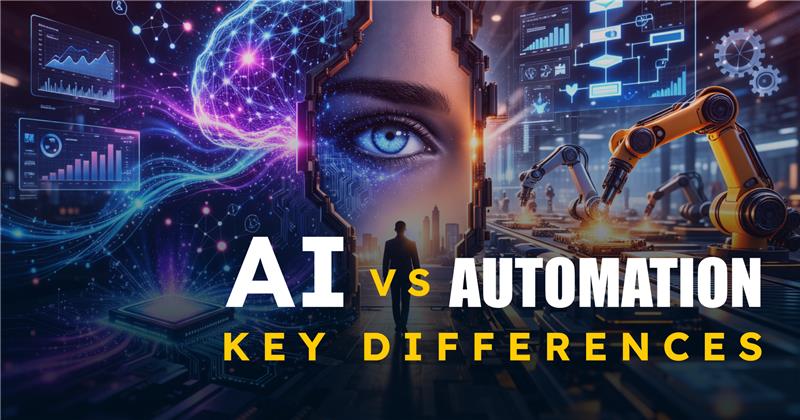
In today’s fast-paced digital landscape, terms like “Artificial Intelligence (AI)” and “Automation” are thrown around constantly. Often, they are used interchangeably in boardrooms, tech articles, and strategy meetings. However, treating them as the same thing can lead to missed opportunities and misaligned business strategies.
While both technologies are designed to make business processes faster, more efficient, and less prone to human error, they operate in fundamentally different ways.If you are looking to digitally transform your business, understanding the distinction between the two is crucial. Here at Lemosys Infotech, we help businesses leverage cutting-edge technologies. In this blog, we will break down the exact differences between AI and Automation, and how you can use both to scale your operations.
What is Automation? (The Muscle)
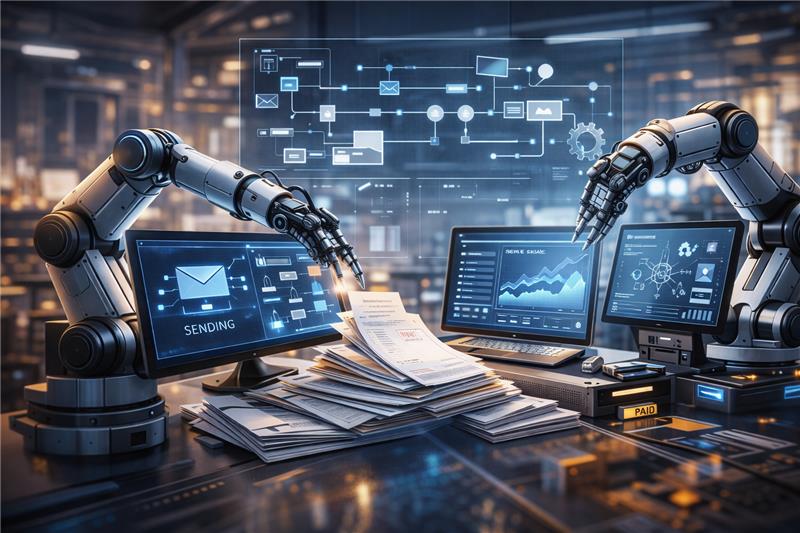
At its core, Automation is about setting up a system to follow pre-programmed rules. It takes repetitive, manual, and time-consuming tasks and executes them without human intervention.
Think of automation as the “muscle” of your operations. It doesn’t think, learn, or make independent decisions; it simply does exactly what you tell it to do, perfectly and repeatedly.
Key Characteristics of Automation:
- Rule-based: It relies on “If X, then Y” logic.
- Structured Data: It requires highly structured, predictable data inputs to function.
- No self-learning: If a new variable is introduced that isn’t in its programming, the automation process will fail or require human intervention to fix.
Examples of Automation:
- Email marketing triggers (e.g., sending a welcome email when a user signs up).
- Data entry and invoice processing using Robotic Process Automation (RPA).
- Software testing scripts.
What is Artificial Intelligence (AI)? (The Brain)
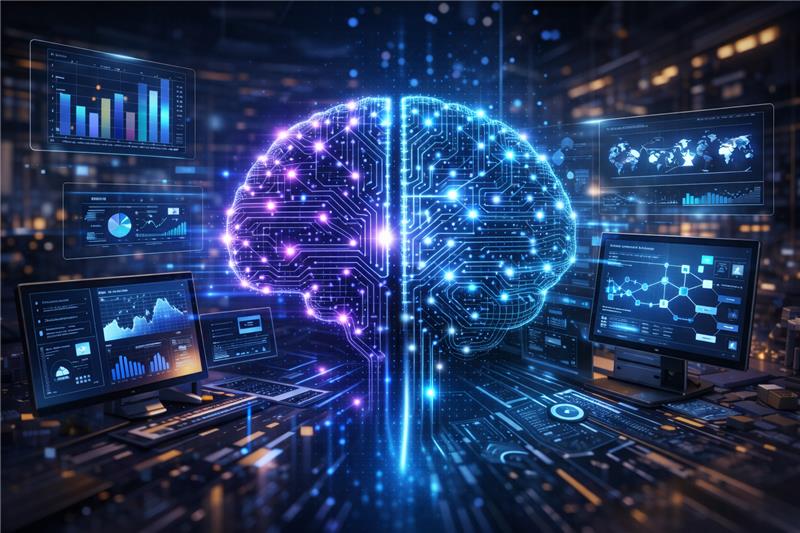
Artificial Intelligence, on the other hand, is designed to simulate human thinking. Rather than just following strict rules, AI uses algorithms and machine learning to analyze data, recognize patterns, learn from experience, and make decisions.
If automation is the muscle, AI is the “brain.” It is designed to adapt to changes, handle ambiguity, and improve its performance over time without needing a human to rewrite its code constantly.
Key Characteristics of AI:
- Adaptive Learning: AI systems learn from historical data to improve future outcomes.
- Unstructured Data: AI can process messy, unstructured data like images, human speech, and free-text documents.
- Decision-Making: It can analyze complex scenarios and recommend or execute the best course of action.
Examples of AI:
- Chatbots (like ChatGPT) that understand context and generate human-like text.
- Predictive analytics forecasting sales trends based on market behavior.
- Recommendation engines on e-commerce websites.
The Core Differences: AI vs. Automation
| Feature | Automation | Artificial Intelligence (AI) |
| Primary Goal | To execute repetitive tasks quickly and accurately. | To mimic human intelligence, analyze data, and make decisions. |
| How it Operates | Follows strict, pre-programmed rules (If/Then logic). | Learns from data patterns and adapts over time. |
| Data Requirements | Requires highly structured, predictable data. | Can handle unstructured, complex data (text, voice, images). |
| Flexibility | Rigid. Breaks if unexpected changes occur. | Flexible. Adapts to new inputs and changing environments. |
| Human Analogy | The Muscle (Execution). | The Brain (Thinking & Learning). |
Better Together: The Rise of Intelligent Automation (IA)
While AI and automation are different, they aren’t mutually exclusive. In fact, they are most powerful when combined. This convergence is known as Intelligent Automation (IA).
By integrating AI’s cognitive abilities with the execution power of automation, businesses can automate highly complex processes end-to-end. For example, while standard automation can sort incoming customer support emails by subject line, adding AI allows the system to actually read the email, understand the customer’s sentiment, generate a personalized response, and automatically send it.
Which One Does Your Business Need?
Deciding between AI and Automation comes down to the problem you are trying to solve:
- If your employees are bogged down by repetitive, high-volume tasks like data entry, file transfers, or simple scheduling, Automation is your best starting point.
- If you need to analyze massive amounts of data, predict future trends, personalize customer experiences, or automate complex decision-making, you need AI.
Ready to Transform Your Business?
Adopting the right technology at the right time is the key to staying competitive in the modern marketplace. Whether you need a robust automated workflow to save hundreds of administrative hours, or a custom AI-driven application to skyrocket your growth, Lemosys Infotech is here to help.
As a leading IT and software development company, we specialize in building smart, scalable solutions tailored to your unique business needs.
Contact Lemosys Infotech today to schedule a consultation and discover how we can help you integrate Automation and AI into your business!